The Hair Fall Diet: What to Eat (and Avoid) for Stronger Hair An Indian doctor's practical guide to the foods, supplements, and home remedies that actually help — and the ones wasting your money.
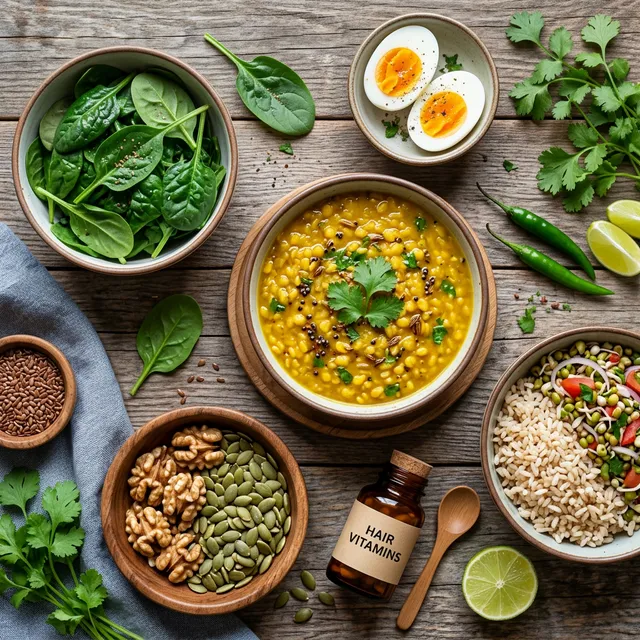
You've probably Googled "best food for hair growth" at 2 AM and found a hundred lists that all say the same thing: eat more protein, take biotin, drink green tea. Helpful? Sort of. Practical for an Indian kitchen? Not really.
Here's the thing most articles miss: your daily Indian thali — when done right — already contains most of what your hair needs. The problem isn't that Indian food is bad for hair. The problem is what we're skipping, what we're overdoing, and what we're missing because nobody told us.
Let me give you a real, doctor-backed food plan for hair fall control — built for how Indians actually eat.
📋 Quick Summary
- Hair is 95% keratin (protein) — skipping protein is the #1 dietary mistake
- Iron, Vitamin D, B12, zinc, and biotin are the 5 critical hair nutrients
- A well-planned Indian thali covers most of these — no fancy supplements needed
- Crash diets, skipping meals, and excess junk food accelerate hair fall
- Most home remedies (onion juice, egg masks) have limited evidence — food comes first
- Get tested before taking any supplements — wrong doses can do more harm
संक्षेप (हिंदी)
बालों के लिए सबसे ज़रूरी पोषक तत्व — आयरन, प्रोटीन, विटामिन D, B12 और जिंक — आपकी रोज़ की दाल, पालक, अंडे, दही और सलाद में मिल जाते हैं। क्रैश डाइट और जंक फ़ूड बालों का दुश्मन है। घरेलू नुस्खों से पहले खानपान सुधारें। Dr. Ajay Agrawal, Mathura।
Why what you eat directly affects your hair
Your hair is essentially dead protein. Each strand is made of keratin — a protein that's built from amino acids, powered by iron-carrying oxygen, and regulated by vitamins and minerals.
Think of it this way: your body has limited resources. When nutrition is scarce, it prioritizes keeping your heart beating and your brain working. Hair is not essential for survival — so it gets cut from the budget first.
💡 Key insight: Hair fall from nutritional deficiency typically shows up 3–6 months after the deficiency starts. So the hair you're losing today might be because of what you didn't eat last winter.
The 6 nutrients your hair can't live without
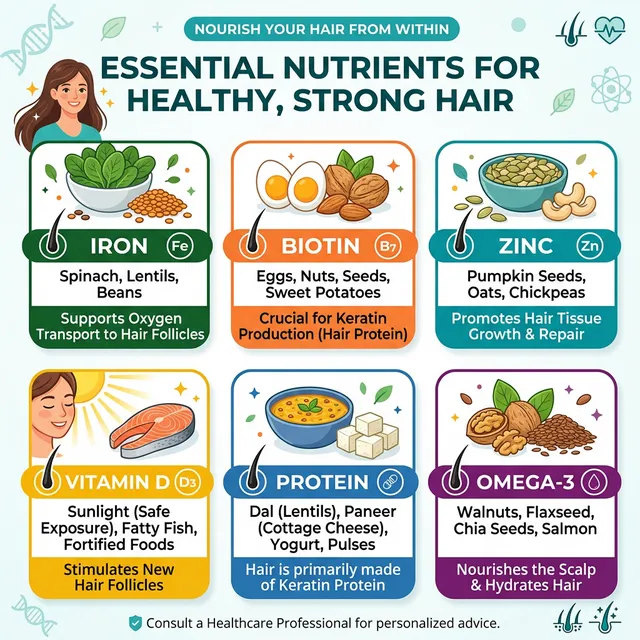
1. Protein — the foundation
Hair is 95% keratin. Without enough dietary protein, your body literally can't build hair. This is the most common deficiency I see in young vegetarian patients who survive on roti-sabzi without dal, curd, or eggs.
Daily target: 50–60g protein (about 1g per kg body weight)
Best sources: Eggs (6g each), paneer (18g per 100g), moong dal (24g per cup cooked), chicken (27g per 100g), soya chunks (52g per 100g), Greek yogurt (10g per cup)
2. Iron — the oxygen carrier
Iron carries oxygen to hair follicles. Low iron = starved follicles = weaker, thinner hair that falls easily. Iron deficiency is the single most common nutritional cause of hair fall in Indian women — and it's increasingly common in young men too.
Best sources: Palak/spinach, rajma, chana, poha (iron-fortified), jaggery (gur), beetroot
✅ Pro tip: Pair iron-rich foods with Vitamin C (lemon, amla, orange) to boost absorption by up to 300%. Avoid drinking chai or coffee within 1 hour of iron-rich meals — they block absorption.
3. Vitamin D — the growth signal
Vitamin D helps create new hair follicles. And guess what? 70–80% of Indians are Vitamin D deficient — yes, even in sunny cities. Working indoors, avoiding sun, and not eating enough eggs or fish does this.
Best sources: 15–20 minutes of morning sunlight (before 10 AM), eggs, fatty fish, fortified milk
4. Vitamin B12 — the circulation booster
B12 is crucial for red blood cell production, which carries nutrients to your scalp. Vegetarians and vegans are at very high risk of B12 deficiency because it's primarily found in animal products.
Best sources: Eggs, curd/dahi, milk, paneer, fortified cereals
5. Zinc — the repair worker
Zinc helps hair tissue growth and repair. It also keeps the oil glands around follicles working properly. Low zinc is linked to hair fall and dandruff.
Best sources: Pumpkin seeds (roasted — great snack), chickpeas, cashews, dark chocolate (yes, really)
6. Omega-3 fatty acids — the scalp nourisher
Omega-3s nourish hair follicles and reduce scalp inflammation. Most Indian diets are heavily skewed toward Omega-6 (from vegetable oils) and low on Omega-3.
Best sources: Flaxseed (alsi), walnuts (akhrot), chia seeds, fatty fish (salmon, sardines)
A practical Indian meal plan for hair health
You don't need exotic superfoods. Here's what a hair-friendly day looks like using regular Indian food:
🌅 Breakfast (7–9 AM)
Option A: 2 boiled eggs + 1 toast + 1 glass milk + 5 soaked almonds
Option B (veg): Moong dal chilla with curd + 1 tbsp flaxseed powder + orange
✅ Covers: Protein, B12, Biotin, Omega-3
🕐 Lunch (12–2 PM)
Option A: 2 roti + rajma/chana + palak sabzi + curd + salad with lemon
Option B: Rice + dal + sabzi + raita + amla chutney
✅ Covers: Iron, Protein, Zinc, Vitamin C (for iron absorption)
🕓 Evening Snack (4–5 PM)
Handful of pumpkin seeds + walnuts + a small piece of dark chocolate
✅ Covers: Zinc, Omega-3, antioxidants
🌙 Dinner (7–8 PM)
Option A: Grilled paneer/chicken + mixed veg + roti + green salad
Option B: Khichdi with ghee + beetroot raita + sautéed greens
✅ Covers: Protein, Iron, B-vitamins, micronutrients
💡 The golden rule: If your plate has dal/protein + green veggies + curd + salad with lemon most days, your hair is getting 80% of what it needs. Consistency beats perfection.
Foods that are quietly worsening your hair fall
| Food/Habit | Why It Hurts Hair | Better Alternative |
|---|---|---|
| Excess sugar & maida | Causes inflammation, insulin spikes → hormonal disruption | Whole grains, jaggery in moderation |
| Crash diets | Starves follicles of nutrients → telogen effluvium | Gradual calorie reduction with protein focus |
| Excess chai/coffee | Tannins block iron absorption | Keep chai 1 hour away from meals |
| Deep-fried foods daily | Excess oil, low nutrients → scalp inflammation | Baked, sautéed, or air-fried options |
| Alcohol (excessive) | Depletes zinc, dehydrates scalp | Limit to 1–2 drinks/week max |
| Skipping meals | Intermittent nutrient deprivation | 3 proper meals + 1 nutrient-dense snack |
Supplements: what's worth it (and what's a waste)
The supplement industry loves hair fall. Walk into any pharmacy and you'll see 20 different "hair growth" supplements. Here's the doctor's honest take:
| Supplement | Worth It? | Doctor's Note |
|---|---|---|
| Iron (ferrous sulfate) | ✅ Yes, IF deficient | Get ferritin tested first. Don't self-dose — excess iron is toxic |
| Vitamin D3 | ✅ Yes, IF deficient | Most Indians need this. Safe to supplement with doctor's dose |
| B12 | ✅ Yes, especially vegetarians | Sublingual or injection — oral absorption is limited in some people |
| Biotin (B7) | ⚠️ Only if truly deficient | Biotin deficiency is rare. Warning: biotin supplements interfere with thyroid & cardiac lab tests |
| Collagen powder | ❌ Weak evidence | Expensive, limited absorption. Better to eat protein-rich food. |
| Random "hair growth" gummies | ❌ Marketing > science | Usually overpriced multivitamins. Test deficiencies and supplement specifically. |
🚨 Important: Never take iron supplements without a blood test. Excess iron (hemochromatosis) can damage your liver and heart. And biotin supplements can give false thyroid readings — always tell your lab if you're taking biotin before a blood test.
Home remedies: doctor's fact-check 🔍
Let's be honest about what actually works and what's just comforting tradition:
🧅 Onion juice on scalp
Verdict: Possibly helpful, limited evidence. One small study showed improvement in alopecia areata. The sulfur content may boost collagen. Worth trying if you can handle the smell — but don't expect miracles.
🥥 Coconut oil massage
Verdict: Good for shaft conditioning, not for root-level growth. Coconut oil penetrates the hair shaft better than most oils and reduces protein loss. Gentle application helps. Vigorous rubbing? That actually pulls out hair.
🍋 Amla (Indian gooseberry)
Verdict: Genuinely useful. Rich in Vitamin C (boosts iron absorption), antioxidants, and has anti-inflammatory properties. Eating fresh amla or drinking amla juice is better than applying it topically.
🍳 Egg hair mask
Verdict: Minor benefits, easier to just eat the egg. Topical protein doesn't significantly penetrate the follicle. Eating 2 eggs gives your body far more biotin and protein than smearing them on your head.
🌿 Aloe vera gel
Verdict: Soothing for scalp, no direct hair growth effect. Reduces dandruff and inflammation, which indirectly helps if those were worsening your hair fall. Good scalp moisturizer.
A real-world example
📖 Case: Vikram, 27, banking professional — "I tried everything before fixing my diet"
Background: Vikram had been losing hair for 8 months. He'd tried onion juice, biotin gummies, two "dermatologist-recommended" shampoos, and a ₹3,000/month hair serum. Nothing worked.
What we found:
- Ferritin: 15 ng/mL (low — optimal is 50+)
- Vitamin D: 11 ng/mL (severely deficient)
- B12: 190 pg/mL (borderline low)
- Diet: Skipped breakfast, had biryani/pizza for lunch, roti-dal for dinner. Minimal protein, no fruits, 5 cups of chai daily.
The fix: Iron + Vitamin D supervised supplementation, 2 eggs daily, reduced chai to 2 cups (away from meals), added curd + salad with lemon to lunch, evening snack of seeds + nuts.
Result after 10 weeks: Ferritin up to 42, Vitamin D up to 38. Hair fall reduced by ~60%. New baby hair visible at temples. Total cost of "treatment"? About ₹200/month in food changes + ₹400 in supplements.
An honest note from the doctor
"Every week, patients ask me for the 'best hair oil' or the 'best supplement.' My answer is always the same: show me what you ate this week.
The most powerful hair treatment isn't in a bottle — it's on your plate. Fix your dal, your eggs, your curd, and your sleep. Then, if you still need supplements, we'll test and prescribe the right ones.
Don't spend ₹5,000 on serums when your body is starving for ₹50 worth of spinach and eggs."
— Dr. Ajay Agrawal, Aurangabad, Mathura
Frequently Asked Questions
Which Indian food is best for hair growth?
The best Indian foods for hair include eggs, palak, dal, rajma, curd, amla, and flaxseed. A balanced thali with dal, sabzi, curd, and salad covers most hair nutrients.
Does oiling hair really help with hair fall?
Light oiling moisturizes the shaft, but it doesn't reverse hair fall from deficiencies or hormones. Gentle application helps. Vigorous massage can worsen shedding.
Should I take supplements without a blood test?
No. Excess iron is toxic, and biotin can interfere with thyroid/heart lab tests. A blood panel (CBC, ferritin, B12, Vitamin D) costs ₹800–1500 and eliminates guesswork.
Need a Personalized Diet Plan for Hair Health?
Every patient is different. Let Dr. Ajay Agrawal review your blood work and design a nutrition plan tailored to your hair fall pattern.

About Dr. Ajay Agrawal
MD Physician in Aurangabad, Mathura with 26+ years of experience in Internal Medicine. Known for patient-first, compassionate care and thorough diagnostic approach.
📱 Share this article
"Stop buying random hair supplements. Here's what a doctor says to actually EAT for stronger hair 🥚🥗 #HairFallDiet #DrAjayAgrawal"
"Bhai ye padh — baalon ke liye kya khana chahiye aur kya nahi, doctor ne proper diet plan diya hai. Indian food se hi kaam ho jaata hai! 🔗"
Related Posts
Why Is My Hair Falling Out? 8 Causes
The 8 real causes of hair fall in young Indians — from stress to thyroid.
Hair Fall: When to See a Doctor?
Tests, treatments, and how to tell normal shedding from a real problem.
10 Tips to Control Sugar at Home
Doctor-approved daily plan for sugar control: diet, walking, medication timing.
Preventive Health Checkups
An age-aware checklist for your yearly health screening.