Hair Fall: When Should You Actually See a Doctor? The exact warning signs, the tests you need, the treatments that work — and the ones that don't.

You've been watching your hair thin for months. You've tried oils, changed shampoos, Googled every remedy. But deep down, you're wondering: "Should I actually go see a doctor about this — or am I overreacting?"
You're not overreacting. But you might be waiting too long. The #1 mistake I see with hair fall patients is this: they come in 2–3 years late, after the easy-to-fix window has already closed.
This guide will help you figure out: when to worry, what to expect at a doctor's appointment, which tests matter, and what treatments actually have science behind them.
📋 Quick Summary
- See a doctor if hair fall persists for 6+ weeks, or if you notice sudden patches, scalp changes, or visible thinning
- Start with a general physician/internist — not a hair transplant clinic
- The essential test panel costs ₹1500–3000 and covers 80% of causes
- Treatments with real evidence: nutritional correction, minoxidil, finasteride, PRP (for specific types)
- Most hair fall in young adults is reversible if addressed within the first year
संक्षेप (हिंदी)
बाल झड़ना कब सामान्य है और कब डॉक्टर को दिखाना ज़रूरी है? कौन से टेस्ट कराने चाहिए? कौन सा इलाज काम करता है? इस गाइड में Dr. Ajay Agrawal ने सब कुछ आसान भाषा में समझाया है। समय पर इलाज से ज़्यादातर बाल वापस आ सकते हैं।
Normal shedding vs. "something's wrong" — how to tell
Let me make this simple with a comparison table:
| Normal Shedding ✅ | Time to See a Doctor ⚠️ |
|---|---|
| 50–100 strands per day | Noticeably more than usual for 6+ weeks |
| Hair falls evenly, no patches | Bald patches, widening part, visible scalp |
| Seasonal increase (monsoon, winter) | Hair fall doesn't improve after season changes |
| New hair growing back at same rate | No new regrowth where hair fell |
| No other symptoms | Accompanied by fatigue, weight change, scalp pain |
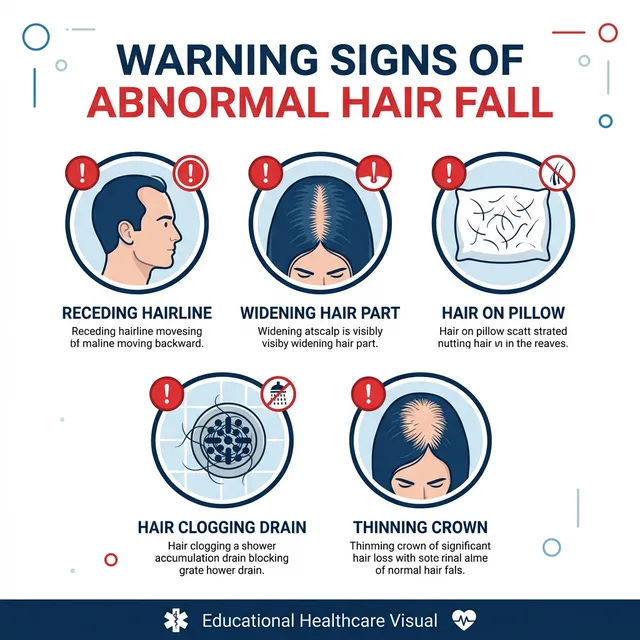
🚨 See a doctor within the week if you notice:
- Sudden circular bald patches (possible alopecia areata — autoimmune)
- Hair falling in clumps after illness, surgery, or emotional trauma
- Scalp redness, scaling, or pain with hair loss (possible fungal infection or inflammatory condition)
- Losing eyebrows or body hair along with scalp hair
- Hair loss + rapid weight gain/loss + extreme fatigue (thyroid or hormonal emergency)
What actually happens at a hair fall consultation
Nervous about visiting a doctor for hair fall? Here's exactly what to expect — no surprises:
History taking (10–15 min)
When did it start? Family history of baldness? Recent stress, illness, or medication changes? Diet habits? Sleep quality? Women: period regularity, pregnancy history.
Scalp examination
The doctor examines your scalp under good light — checking for thinning patterns, scalp health, dandruff, redness, or patches. Sometimes a pull test (gently tugging 40–60 hairs).
Blood tests ordered
Based on findings, the doctor orders targeted blood work. Results usually come back in 24–48 hours.
Diagnosis + treatment plan
At the follow-up, you get a clear diagnosis and a step-by-step plan: nutritional corrections, medications if needed, lifestyle changes, and a timeline for improvement.
💡 Important: Go to a general physician or internist first — not a hair transplant clinic. Most hair fall is a medical problem that needs blood work and diagnosis, not a procedure. If it turns out to be pattern baldness, your doctor will refer you appropriately.
The hair fall test panel: exactly what to get done
| Test | What It Checks | Est. Cost (₹) |
|---|---|---|
| CBC (Complete Blood Count) | Anemia, infection markers, overall health | 200–400 |
| Serum Ferritin | Iron stores (more accurate than hemoglobin alone) | 300–500 |
| Vitamin D (25-OH) | Vitamin D levels — deficiency is extremely common | 400–800 |
| Vitamin B12 | B12 levels — especially important for vegetarians | 300–600 |
| Thyroid Panel (TSH, T3, T4) | Thyroid function — hypo/hyperthyroidism | 300–600 |
| Fasting Blood Sugar | Diabetes screening (diabetes worsens hair health) | 100–200 |
Total estimated cost: ₹1,500 – ₹3,000 at most labs (Thyrocare, SRL, Lal PathLabs, etc.)
For women with irregular periods or suspected PCOS: Add hormonal panel (LH, FSH, testosterone, DHEAS, prolactin) — approximately ₹1,500–2,000 extra.
✅ Pro tip: Get tested fasting (empty stomach, early morning) for most accurate results. Bring ALL previous reports to your appointment — trends matter more than single values.
Hair fall treatments: what actually works (evidence-based)
Level 1: Fix the root cause (always start here)
If tests reveal deficiencies, thyroid issues, or hormonal imbalances — treating the cause is the treatment. No fancy procedure needed.
- Iron/Vitamin D/B12 deficiency: Supervised supplementation + diet correction → visible improvement in 6–12 weeks
- Thyroid disorder: Thyroid medication (levothyroxine for hypo) → hair typically recovers in 3–6 months
- Stress-induced (telogen effluvium): Stress management + sleep + nutrition → self-resolving in 3–6 months
Level 2: Medical treatments (prescription)
| Treatment | How It Works | Evidence Level | Doctor's Take |
|---|---|---|---|
| Minoxidil (topical) | Widens blood vessels → more nutrients to follicles | ⭐⭐⭐⭐ Strong | FDA-approved. Works for many. Must be used continuously — stopping = hair falls again. |
| Finasteride (oral, men only) | Blocks DHT → slows pattern baldness | ⭐⭐⭐⭐ Strong | Effective but prescription-only. Has potential side effects — discuss thoroughly with your doctor. |
| PRP (Platelet-Rich Plasma) | Your blood platelets injected into scalp → growth factors | ⭐⭐⭐ Moderate | Promising results in some patients. Best as add-on, not standalone. Costly: ₹3,000–8,000/session. |
| Low-Level Laser Therapy | Red light stimulates follicle activity | ⭐⭐ Emerging | Some positive data. Non-invasive. Can try as supplement to main treatment. |
Level 3: Surgical (last resort)
Hair transplant is an option for advanced pattern baldness that hasn't responded to medical treatment. But it's expensive (₹50,000–2,00,000+), requires realistic expectations, and should never be the first step.
🚨 Warning: If a "hair clinic" pushes you toward transplant or expensive procedures without running basic blood tests first, walk out. Any reputable doctor will diagnose before treating.
A real-life case: "I wish I'd come sooner"
📖 Case: Rohit, 29, marketing executive — 2 years of ignoring hair fall
The story: Rohit noticed thinning hair at 27 but brushed it off as "stress." He tried minoxidil from a pharmacy without a prescription, used it irregularly for 4 months, then stopped. Two years later, his hairline had receded significantly, and his crown was visibly thin.
What we found:
- Family history: Father and maternal uncle both bald by 40 (androgenetic alopecia)
- Vitamin D: 16 ng/mL (deficient)
- Ferritin: 22 ng/mL (low)
- TSH: Normal
- Diagnosis: Androgenetic Alopecia (grade III) + nutritional deficiency worsening it
Treatment plan: Consistent minoxidil 5% (this time with proper guidance), Vitamin D + iron supplementation, stress management, and realistic goal-setting. PRP sessions considered for 6 months later if response is partial.
The lesson: "If Rohit had come at 27 instead of 29, we'd have caught this at grade I–II, and the response to treatment would have been significantly better. Early action = more hair saved."
What to say at your appointment
Feeling awkward about discussing hair fall? Use this ready-made script:
Bringing this level of preparation to your appointment saves time, shows you're serious, and helps your doctor help you faster.
An honest note from the doctor
"The biggest enemy of hair fall treatment isn't genetics or stress — it's delay.
Every month you wait, some follicles that could have been saved become permanently dormant. I've seen patients who came in early lose half as much hair as those who waited years with the same condition.
Hair fall is not vanity — it affects your confidence, your mental health, and your quality of life. Come in early. We'll sort it out together."
— Dr. Ajay Agrawal, Aurangabad, Mathura
Frequently Asked Questions
What tests should I get for hair fall?
CBC, serum ferritin, Vitamin D (25-OH), B12, thyroid panel (TSH, T3, T4), and fasting blood sugar. For women with irregular periods, add a hormonal panel. Total: ₹1500–3000.
Is PRP treatment effective for hair fall?
PRP has moderate evidence for androgenetic alopecia. Works best as an add-on to other treatments, not standalone. Results vary by patient. Discuss realistic expectations with your doctor.
General physician or dermatologist — who should I see first?
Start with a general physician who can run basic tests and find underlying causes. If it's pattern baldness, alopecia areata, or scalp disease, they'll refer you to a dermatologist.
Can hair loss be reversed?
Hair loss from deficiencies, stress, thyroid, and medications is usually reversible. Pattern baldness can be slowed and partially reversed if caught early, but is harder to fully reverse in later stages.
Ready to Get Your Hair Fall Checked?
Don't wait another month. Walk in with your questions — Dr. Ajay Agrawal will help you find the cause and build a plan that works for your hair and your budget.

About Dr. Ajay Agrawal
MD Physician in Aurangabad, Mathura with 26+ years of experience in Internal Medicine. Known for patient-first, compassionate care and thorough diagnostic approach.
📱 Share this article
"Not sure if your hair fall is normal? Here's when to see a doctor, what tests to get, and which treatments actually work 🩺💇 #HairFall #DrAjayAgrawal"
"Agar baal bahut jhad rahe hain toh ye guide zaroor padho — doctor ne bataya hai kab doctor ko dikhana chahiye, kaunse tests karwane hain, aur kaunsa ilaaj kaam karta hai. 🔗"
Related Posts
Why Is My Hair Falling Out? 8 Causes
The 8 real causes of hair fall in young Indians — stress, diet, thyroid & more.
The Hair Fall Diet: Foods That Work
Indian diet plan, supplements, and home remedy fact-checks for stronger hair.
How to Read Blood Test Results
A simple guide to interpret CBC, lipid profile, and blood sugar reports.
Normal Tests But Still Unwell?
Why labs miss things and what to do when reports say "normal" but you don't feel it.